See your campaigns and pages the way your buyers will. Before you launch.
Your champion loves the page. The one who quietly vetoes never tells you. WhyUser shows you which role blocks the deal, what proof was missing, and what to change. Every finding is sourced to your buyers' own words, so you can forward it instead of defending it. Thirty minutes, from a URL.
Across live accounts. Every call graded HIT or MISS by your team against your own data, never by us. See all 473 →
From a URL to a committee verdict. Against review rounds that take weeks. Read a real report →
Trusted By

 + NDA design partners
WhyUser is a buying committee simulation that runs before you launch a B2B campaign. Your reviewers know the product, so they read the page as ideal users. Real buyers arrive rushed and skeptical. WhyUser runs at least 30 agents per committee seat, each rushed, skeptical, or ideal, and each built from your sales calls, reviews, and community threads. It finds the silent vetoes, the missing proof, and the bounce risk that internal reviews and AI chatbots miss. Every finding cites its evidence, so you can forward instead of defending it.
Marketing is the only team that opens without a rehearsal.
Your reviewers already understand your page. Your buyers won’t. Engineering has staging. Sales rehearses the pitch. Marketing goes straight to opening night, then buys traffic to find out if the message landed. WhyUser is the rehearsal. It shows who walked away, what proof was missing, and the fix.
“Every role approved. The deal still stalled. Nobody says why.”
Committee Simulation
Which buyer role killed it, and the missing proof.
Conflict Graph 02 Wasted spend“Ad budget pours into a page that was never going to convert.”
Ad Campaign Simulation
The ad-to-page gap, caught before you spend.
Kill Sheet 03 Flat sends“One email to three roles wins for none of them.”
Email Campaign Simulation
The subject and CTA that win for each role.
Per-Persona Winner 04 Stale targeting“You target last year’s titles and bid against every competitor.”
Audience Discovery
The roles your content actually fits.
Ranked Title PoolWhyUser gives me the ammunition I need to make the case internally. To engineering. To leadership. To sales. It's not just telling me a page is broken. It's showing me exactly which buyer role bounces, why, and what to fix. That's gold for a lean marketing team.
A verdict you can forward, not an opinion you defend.
Every finding names the role, the line they were reading, and the buyer trait that made them look. That trait was built before your page existed.
The conflict graph
Seven handoffs between five roles. You see which ones snap, and why. A page every role approves can still be dead. An average hides that.
A ranked fix queue
Ranked by which snapped handoff each fix reconnects, not by page order. Tick one and watch the graph reconnect before you write any code.
Evidence on every claim
Each finding states its confidence and sample size. Low confidence comes back marked low confidence, not quietly dropped.
A replayable record
Same fingerprints, same buyers. A run is replayed, not re-rolled. So a fix is a fix, not model drift.
A landing page, an ad campaign, an email send, and an audience study. These are the full reports a customer gets. One is our own homepage. It found our nav hard to scan and our proof thin. We published that one too.
Not another review round. The one that ends them.
No new cycle, no new process. WhyUser fills the gap between review and launch with one 30 minute answer. That gap is where silent vetoes slip through today. Run it in-app or via API.
WhyUser · Test
Test the ad, email, or page against the buying committee. See which persona vetoes, what proof is missing, where the bounce risk hides, sourced to real buyer reviews.
You already run Plan → Build → Review → Launch → Measure. WhyUser adds one 30 minute test step. Catch what is broken before launch, not six weeks after the spend.
Not imaginary AI characters. Not a static profile with a chatbot attached.
We compile your buyers based on evidence from your site, your customer calls, and community and competitor voice. Each persona updates as new evidence lands, so it never drifts. That makes a finding forwardable, not arguable.
Six inputs become one buyer agent, with a role, a mood, and a way of deciding. Every run fields 30 or more per committee seat. You set the number.
Compiled from evidence, before and after they engage.
One buyer, from one run. Not an invented character. 42 things that hold steady: the role they own, how they behave, the biases they decide with, what blocks a yes. 58 that move: what hurts right now, what they want, what would convince them, who they compare you to. The moving half updates as new evidence lands, from community and competitor voice, your sales conversations, how the campaign actually performed, and what your team learns next. That is why a finding is forwardable rather than arguable.
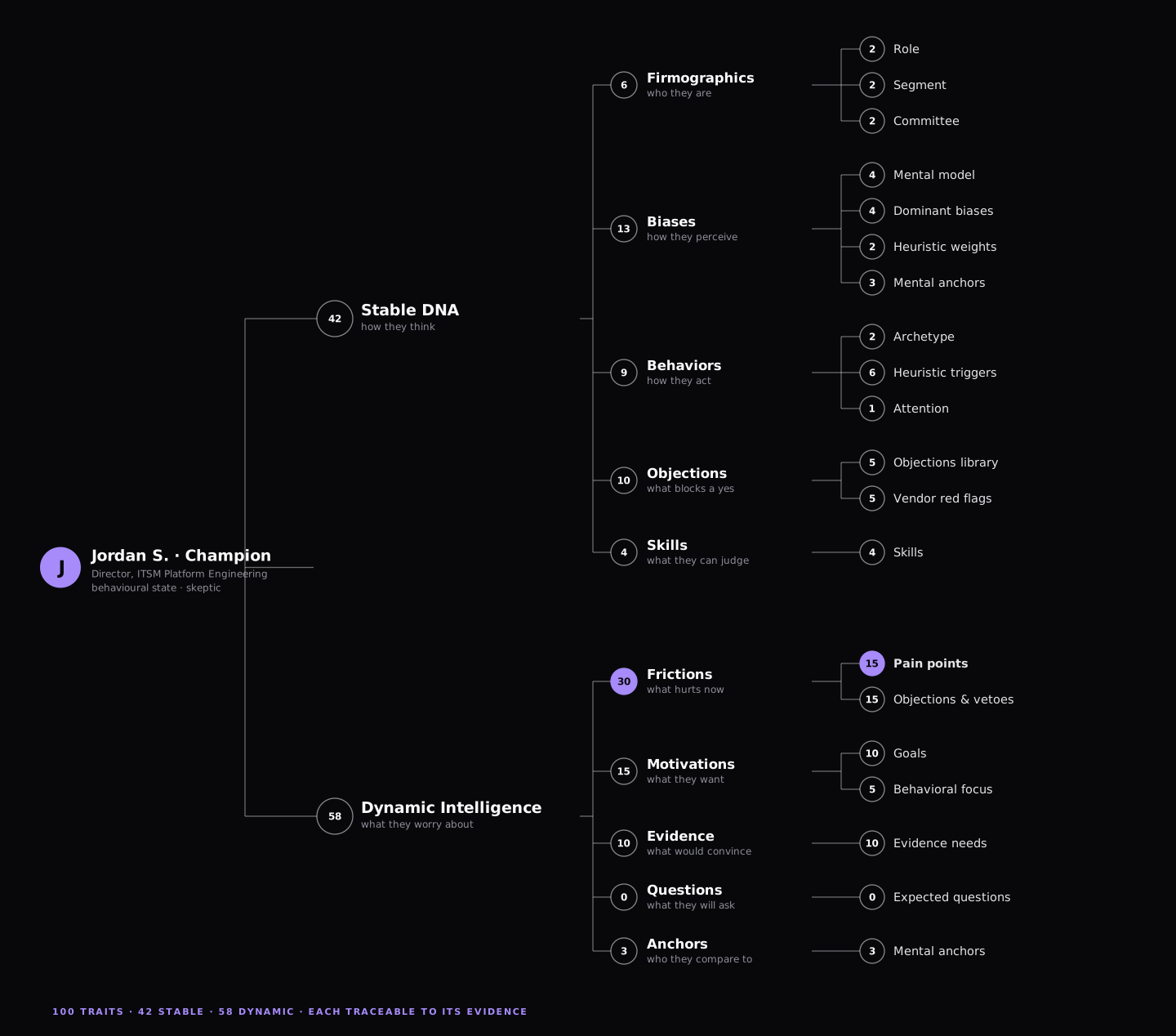
Most tools require weeks of manual data mapping and setup before you can even plan or launch a campaign. WhyUser's 'Ground Reality' onboarding ingested our site, social sentiment, and customer transcripts in minutes, creating a foundation that actually understands our business and users. The platform operates from that understanding instead of relying on prompting. You're not starting from scratch every time you test, and it keeps learning.
Four things that separate a simulation from a guess.
Anyone can ask AI what it thinks of a page. Four things turn an opinion into a verdict you can defend: a real agent per role, at least 30 of them in different moods, the same answer every run, and a graded track record.
A committee, not a cast.
WhyUser runs one agent per committee role, not one agent playing five parts. Miss the ROI proof and the Economic Buyer vetoes. The veto is computed from the evidence the page is missing, never scripted in advance.
Many moods, not one.
Every role is run in three behavioral states: rushed, skeptical and ideal, across 30 or more agents each, and you set the number. You get a distribution, not one take. Loop a chatbot 30 times and you get one opinion 30 ways.
Same page in, same verdict out.
WhyUser is deterministic at the element level: the same page in produces the same verdict out. Fix one section, re-run, and you know whether that change is what moved the result. A chatbot writes a new essay every time.
Your 10th simulation is better tuned than your 1st.
WhyUser keeps learning about your buyers with every run. Each finding is graded HIT or MISS against what actually happened, and the result carries forward. One loud quote stays an outlier until other buyers confirm it.
Lineage and the Evidence Tracker, from one run. Each version re-tests only what you changed. The rest carries forward.
Six ways to pressure-test a campaign. We do not win every row.
Chatbots give opinions. WhyUser gives simulations you can repeat and grade. Each option below is best at a different job.
| ChatGPT | A/B Test | Internal Review | Agents / Claude Code | WhyUser | |
|---|---|---|---|---|---|
| Works before you spend budget | Yes | No | Yes | Yes | Yes |
| Tests behavior, not just reads copy | No | Yes | No | Partial: Possible - but you build and maintain it | Yes |
| Models the buying committee | No | No | No | Partial: Possible - but this is the hard part you would be building | Yes |
| Catches "every role approves, deal still stalls" | No | No | No | No | Yes |
| Repeatable, same input, same verdict | No | No | No | No | Yes |
| Proves it on live traffic | No | Yes | No | No | No |
| Time to first result | instant | 4–6 weeks | ~2 weeks | weeks to build | ~30 min |
| What it costs | free | $10K+ in traffic | team hours | build + upkeep | credit-based |
Agents / Claude Code can build these, but you build the infrastructure, state management and determinism of probabilistic models yourself and maintain it through every model update.
Every other method reads the page. Only a committee graph scores the handoff between roles, which is where a page that everyone approves still fails to move a deal.
See the difference for yourself, one landing page, judged two ways.
AI Opinions vs. WhyUser SimulationsIf any of these are you, save your time.
WhyUser is a poor fit for four groups. Better you know now than after a procurement cycle.
CMOs at 500+ person companies.
Your team needs the artifact, not you. We sell directly to your VP of Demand Gen instead.
Product marketing or content roles.
Different sale shape. We focus on the buyer who owns paid distribution and pipeline accountability.
B2C, e-commerce, or non-technical SaaS.
Buying committees are shallow here, so the evidence carries less weight. The math doesn't work for you yet.
Marketers who believe more AI throughput will fix conversion.
It won't. Come back after the campaign that taught you that.
Five questions we get every week.
The rest are on the full FAQ, including what WhyUser will not do.
Are these real people?
No, and we will never imply otherwise. The agents are simulated. What is real is the evidence they are built from: your buyers' own words in reviews, community threads and your call transcripts, with every finding traceable to its source. The honest description of a WhyUser output is a grounded hypothesis, not a survey result. If that distinction matters to you, grade us on it. Run a campaign whose ending you already know and see whether the simulation catches what happened.
How is this different from a research panel?
A panel's unit is the individual respondent. It shows your page to forty people separately and returns forty opinions. Those are real humans, which ours are not. What a panel cannot do at any price is put the roles in the same room: it never sees the CFO's veto land on the champion's enthusiasm, because those two were surveyed independently. That chain reaction is what WhyUser models, and the gap is structural rather than a matter of panel size.
What do I need to get started, and how long does a run take?
A public URL is enough to begin. The Ground Reality step reads your site, the public voice of your buyers, and your campaign context, then compiles your committee from that evidence. No prompt writing, no weeks of data mapping, and nothing to install on your side. A run takes about thirty minutes, against review rounds that usually take weeks.
What does it cost?
Annual plans with a credit allowance. Standard is $12,000 a year for 2,400 credits, which is 240 landing page tests. A landing page run is 10 credits, or $50. There is no charge at all while you are a design partner. Full pricing and the credit rates →
Why not just use ChatGPT or Claude?
For drafting and variants, do. For a spend decision, no. A chatbot answers as one voice rather than a committee, reads as the most attentive reader alive when most of your traffic is distracted, gives a different answer each time you ask, and hands you a menu you then filter through your own bias. Your competitors have the same tool and get the same advice from it, so it cannot be a source of differentiation.
Fail in the test.
Win in the market.
Tell us about the next campaign you have going live. We respond within 48 hours.
No charge during the program. Post-program: only if it earns its place in your stack.
One short feedback call with our founder while you are in the program. We use it to guide product direction.
You drive B2B traffic. Campaigns going live in the next 30 days. You can change them.